Satellite images reveal Israeli forces’ path into Gaza
Dozens of military vehicles advance into territory already pitted with craters from bombardments
Ground offensive in Gaza began in earnest, tanks and armoured vehicles rumbled into the coastal enclave through breaches in the border wall that surrounds it.
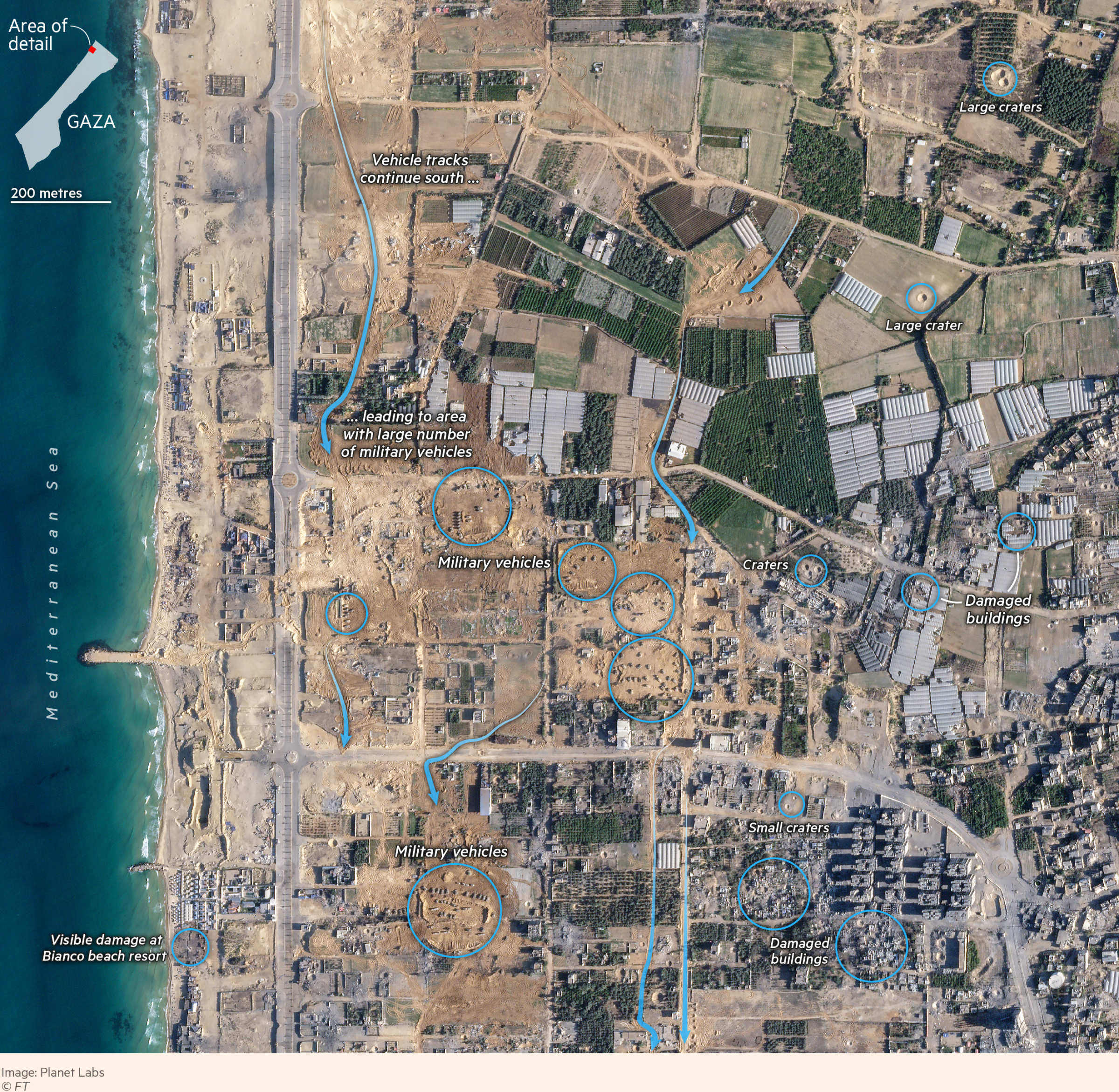
Since launching its incursion over the weekend, Israel’s military has been tight-lipped about how many troops it has committed to its biggest operation in years, and about where they are now. But satellite imagery published by Planet Labs shows a significant invasion: dozens of armoured vehicles are now at least 5km inside the territory on the northern outskirts of the strip’s capital Gaza City, poised to move deeper towards Hamas’s political and military centre of power.
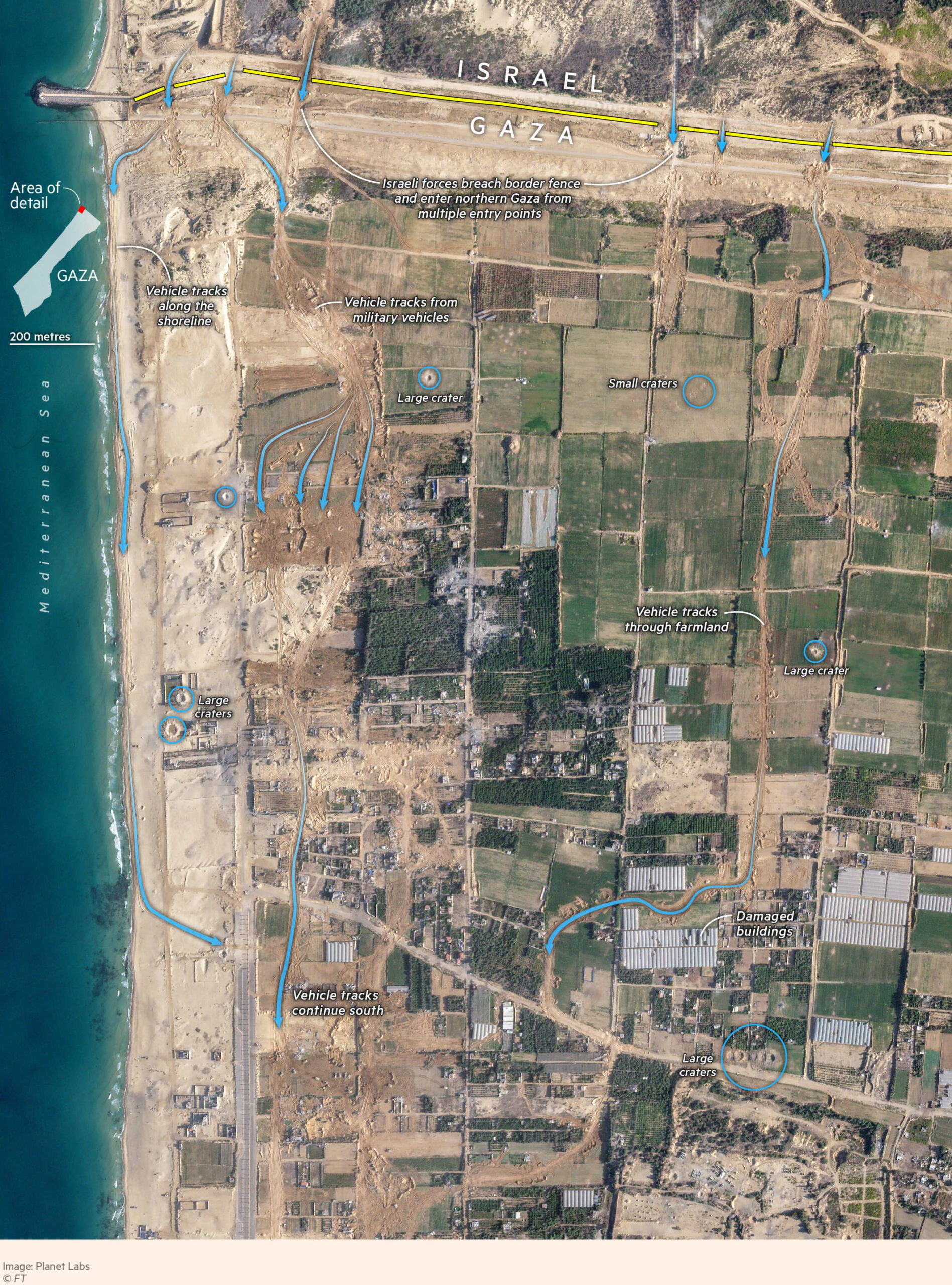
Israel entered Gaza —which has been controlled by Hamas since 2007 — from numerous points in the north, and from the east. The image here shows the push into Gaza from the north-west. After they breached the barrier wall in at least six places, vehicle tracks show how Israel’s columns cut through the sparsely populated farmland to the south of the border, before making their way deeper into Gaza towards more populated areas.
The image also shows signs of the ferocious aerial bombardment to which Israel has subjected Gaza since Hamas militants launched the deadliest ever attack on Israel three weeks ago. Buildings appear to have been damaged, and the fields are scarred by several large craters.
Farther south, the destruction from Israel’s bombardment is more intense. Buildings including a beach resort appear to have been damaged, and numerous craters are blasted into the ground.
According to Palestinian health officials, more than 8,500 people have been killed in Gaza and more than 21,500 injured since Israel began bombing the territory in response to the Hamas attack on October 7, which killed more than 1,400 people in Israel, and injured more than 5,350.
The death and destruction in Gaza has been immense. Entire neighborhoods have been flattened by Israeli airstrikes, reducing apartment buildings to piles of rubble. Streets are filled with debris and downed power lines. Access to basic necessities like food, water and electricity has been severely disrupted. Hospitals are overwhelmed with wounded civilians, many of them women and children.
The Gaza Strip, measuring just 25 miles long and 5 miles wide, is one of the most densely populated places on earth. Its 2 million residents, already living in poverty under Hamas rule and an Israeli-Egyptian blockade, have nowhere to flee the bombardment. Many have died inside their homes or on the streets trying to escape.
“I have never seen such extensive destruction ever before,” said Muhammad Shehada, a Gaza-based researcher with the Euro-Med Human Rights Monitor. “There is no place that was safe from Israeli missiles.”
According to the United Nations, at least 40 schools in Gaza have been damaged during the conflict, some serving as shelters for displaced residents. At least six hospitals and clinics have also sustained damage, hindering the ability to care for the ceaseless influx of wounded.
Doctors Without Borders said one of its clinics was damaged so extensively by an airstrike that it can no longer be used. “It is unbearable to witness such a high level of violence targeting civilians and civilian infrastructure,” the aid group said.
Save the Children, noting that half of Gaza’s population is under age 18, said that 43 children had been killed over a two-day period last week. “The complete disregard for civilian life is staggering,” the organization said, appealing for an immediate cease-fire.
Israel says it tries to avoid civilian casualties but blames Hamas for locating military infrastructure in residential areas. Israeli officials note that Hamas and other militant groups have fired thousands of rockets indiscriminately into Israel in recent days, killing both Israeli civilians and soldiers.
But human rights groups maintain that even if Hamas is putting civilians at risk, that does not absolve Israel of responsibility under the rules of war. They accuse the Israeli military of using disproportionate force that amounts to collective punishment of the entire population.
“There is no question that Hamas’ indiscriminate rocket attacks are war crimes, but they do not justify the vastly disproportionate Israeli artillery, tank and airstrikes killing scores of civilians,” said Brad Parker, an attorney with Defence for Children International.
The Israeli military said on Tuesday that troops were “conducting fierce battles against Hamas militants deep in the Gaza Strip” as they attacked “hundreds” of Hamas targets, without giving details of the locations of the fighting.
Officials from Hamas and Palestinian Islamic Jihad, a smaller militant group, told the Financial Times that tens of Israeli tanks had been trying to advance under air cover in north-west Gaza and in the south of Gaza City amid fierce battles.
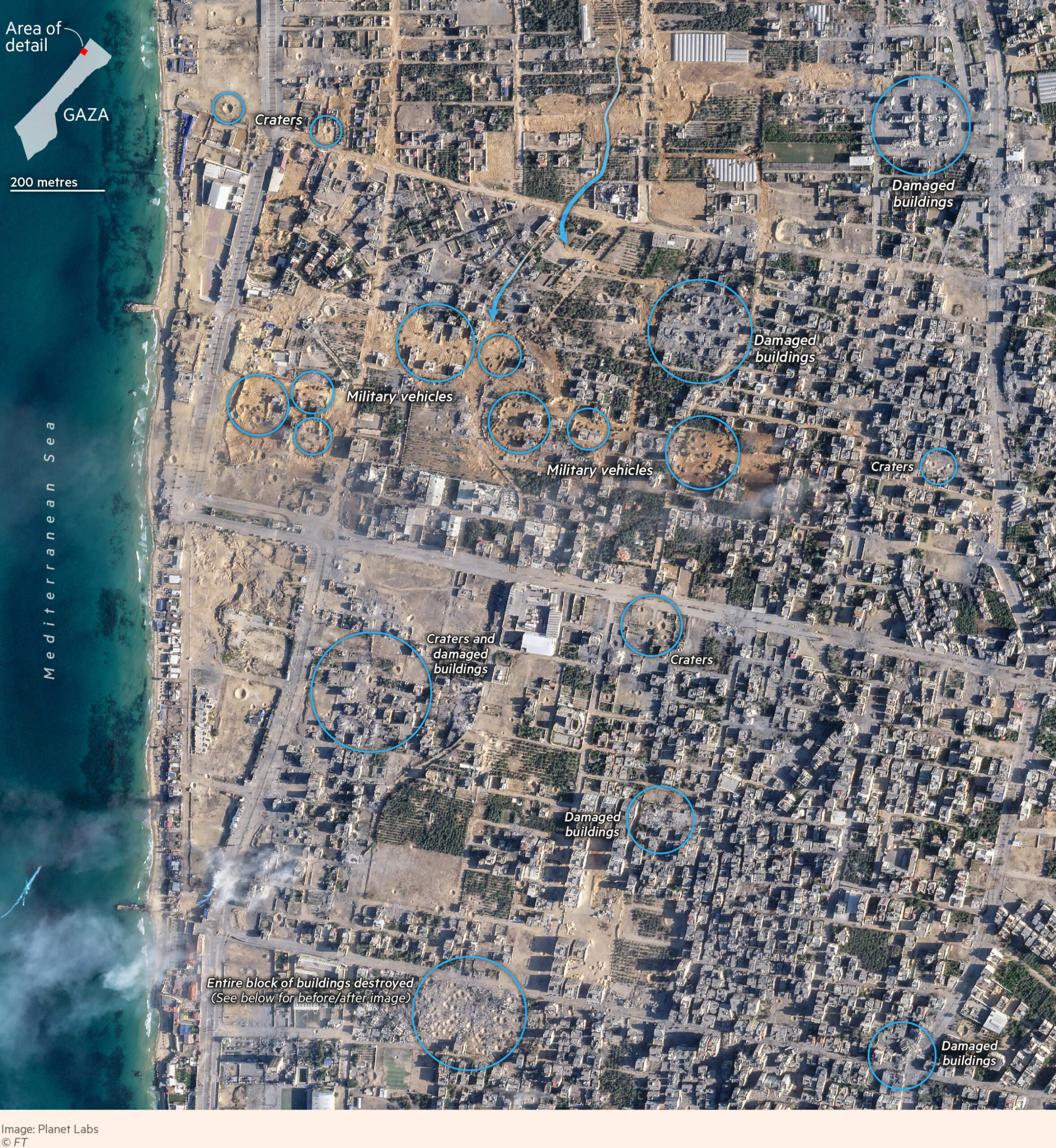
The aerial image, from an earlier stage in the fighting on Monday morning, shows that dozens of Israeli tanks or armoured vehicles had already reached locations in north-west Gaza about 3km south of the border by then.
The Hamas-controlled interior ministry in Gaza said on Tuesday that Israeli forces had reached the Karama area and had also positioned tanks on Salah al-Din street, the main inland north-south axis in the enclave.
It added that the Israelis were “trying to separate the north of Gaza from its south”, ahead of an expected attempt by Israel to advance deeper into Gaza City.
Ahead of its ground invasion, Israel repeatedly ordered Gazans to leave the north of the territory and head south. More than 1.4 million people have been displaced in Gaza since the Israeli bombing campaign started, according to the UN, with nearly 672,000 sheltering in 150 UN facilities. The average number of displaced people per shelter was more than three times their intended capacity, the UN said.
The satellite image also shows the devastating toll that the war has taken on more built-up parts of Gaza, with dozens of craters in residential areas, and one entire neighborhood appearing to have been destroyed.
The situation in Gaza is dire and worsening by the day. According to the UN, nearly half the population does not have reliable access to clean drinking water. Seventy percent lack access to proper sanitation. Health care workers are struggling to maintain basic services amidst the chaos. Supplies of food, fuel and medicine are running dangerously low.
UN Secretary General Antonio Guterres called Gaza “hell on earth” and appealed for an immediate ceasefire. The International Committee of the Red Cross warned that people in Gaza are facing an “unprecedented crisis” and that hostilities must stop immediately.
“The violence in the Gaza Strip, the West Bank and Israel is outrageously high,” said Robert Mardini of the Red Cross. “It must stop now.”
But Israeli Prime Minister Benjamin Netanyahu vowed the offensive will continue at “full force” for as long as necessary, saying Hamas must be dealt a “very heavy blow.” Hamas leaders in turn have said the militant group will keep firing rockets into Israel until Israeli forces leave Gaza.
With the dueling sides refusing to back down, the international community is ramping up diplomatic efforts to halt the conflict before it deteriorates into an even bloodier war. The United States dispatched an envoy to the region. Egypt and Qatar are attempting mediation. The UN Security Council held emergency meetings but failed to agree on a joint statement calling for a cease-fire.
In the meantime, ordinary civilians on both sides of the Gaza border continue bearing the horrific consequences. More than 10,000 Palestinians have been injured, overwhelming hospitals already suffering from COVID-19 and short on staff, supplies and electricity. Psychiatrists are reporting a surge in traumatic stress and depression.
In Israel, civilians hide in bomb shelters or flee rocket fire from their communities. At least 12 people in Israel have been killed so far. “Both sides need to de-escalate,” said UN spokesman Stephane Dujarric. “The suffering of civilians needs to stop immediately.”
As the crisis continues with no clear endgame in sight, the satellite images provide a sobering look at the devastation unfolding in Gaza. They reveal how Israel has leveraged its superior military power to unleash widespread destruction on both infrastructure and lives within the impoverished and blockaded territory.
For the 2 million Palestinians trapped in Gaza, it’s the latest chapter in what human rights advocates call an endless collective punishment with no way out. More than 60 children have already been killed in missile strikes on their homes, schools and neighborhoods.
“Children and families have nowhere to escape,” said Olivia Headon of the UN relief agency UNRWA. “They do not feel safe at home, at schools or in the streets.”
🚀 Wow, blog ini seperti perjalanan kosmik meluncurkan ke galaksi dari kegembiraan! 🌌 Konten yang mengagumkan di sini adalah perjalanan rollercoaster yang mendebarkan bagi imajinasi, memicu kegembiraan setiap saat. 💫 Baik itu inspirasi, blog ini adalah harta karun wawasan yang menarik! #TerpukauPikiran Terjun ke dalam pengalaman menegangkan ini dari imajinasi dan biarkan pemikiran Anda terbang! 🌈 Jangan hanya mengeksplorasi, alami kegembiraan ini! #MelampauiBiasa Pikiran Anda akan bersyukur untuk perjalanan mendebarkan ini melalui dimensi keajaiban yang tak berujung! 🌍
Great content from the article